3Sixty27 – Better 3D Scenes
3Sixty27 has been released. It is now better, faster and more optimized. With new 3D Scenes feature, you can make more interesting virtual tour.

3Sixty27 has been released. It is now better, faster and more optimized. With new 3D Scenes feature, you can make more interesting virtual tour.
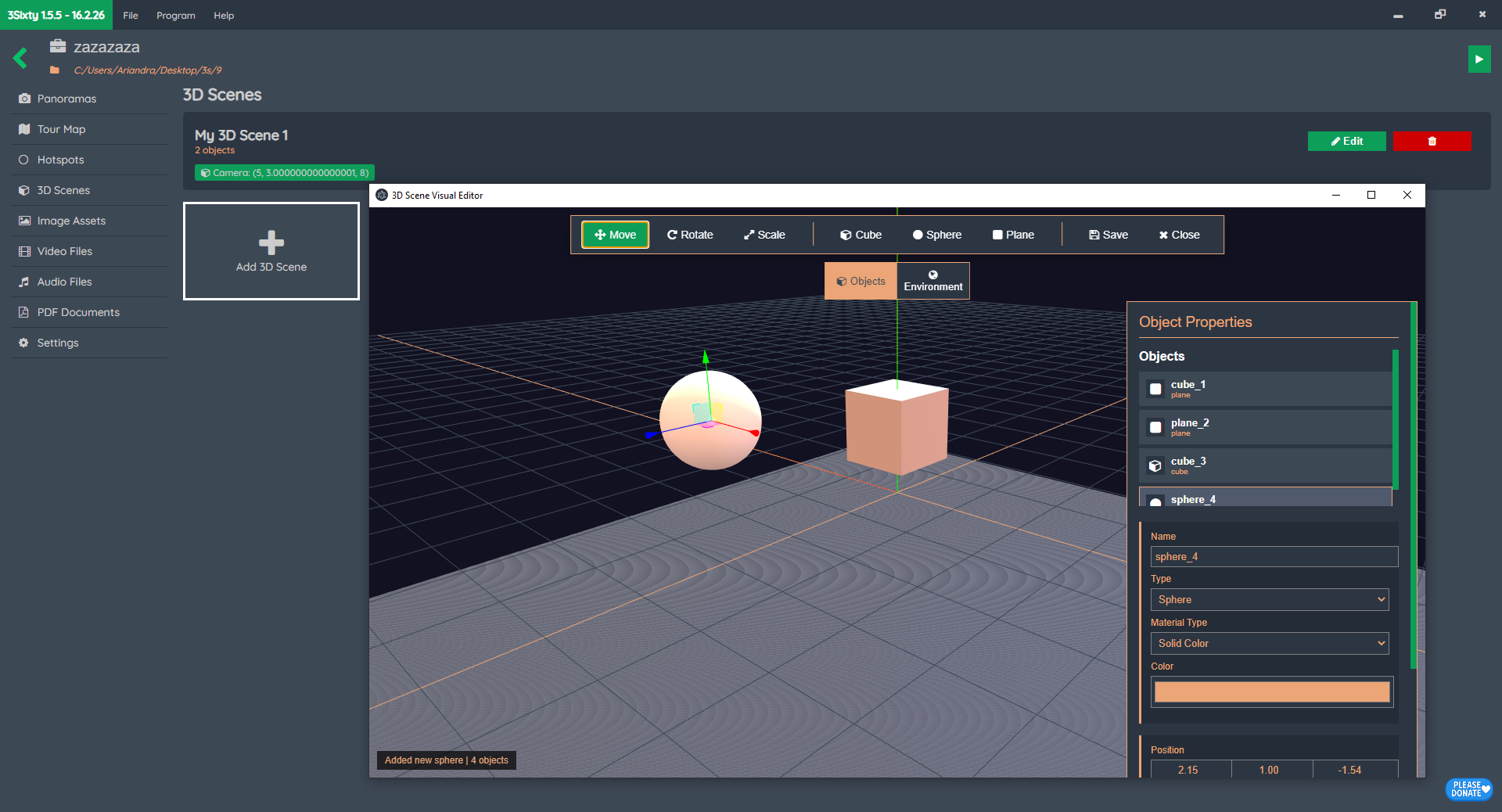
Wih, mantap nih update-nya! Fitur “3D Scene” pakai Three.js itu big deal banget buat platform virtual tour. Kodenya juga kelihatan sudah pakai Electron dan punya sistem properties panel yang rapi.
Berdasarkan draf kamu, ini ada 3 opsi copywriting dengan gaya bahasa yang beda-beda (Professional, Enthusiastic, dan ala Startup Silicon Valley) supaya audiens kamu makin tertarik buat nyobain fitur eksperimental ini.
Headline: Introducing 3D Scene: Elevate Your Virtual Tours with Interactive Environments
I’m excited to announce the latest update for 3Sixty. This release introduces an experimental feature: 3D Scene.
With this new visual editor, you are no longer limited to flat panoramas. You can now:
Embed 3D Objects: Add cubes, spheres, and custom planes directly into your virtual space.
Visual Editor: Manipulate objects in real-time with intuitive Move, Rotate, and Scale tools.
Enhanced Interactivity: Create a more immersive experience by blending 3D elements with your 360° tours.
This feature is currently in experimental mode, and I can’t wait to see the creative ways you use it to engage your audience. Update your 3Sixty now and start building!
Headline: Level Up! 🚀 3Sixty Just Got a 3D Reality Boost!
Ever felt like your virtual tours needed that extra “pop”? 3Sixty just got a massive update that changes the game!
I’ve just pushed a recent update featuring the experimental “3D Scene” Visual Editor. Now you can actually build inside your tours! Want to add interactive 3D elements or create a more engaging environment? You got it.
What’s new: ✅ 3D Object Support (Cubes, Spheres, Planes) ✅ Texture & Material Control (Add your own images to 3D shapes!) ✅ Interactive Gizmos for easy spatial editing. ✅ Custom Action Triggers for every object.
Go grab the update, play around with the 3D Scene, and let’s make virtual tours more immersive than ever!
Headline: 3Sixty Update: The 3D Scene Era is Here! 🌐
Virtual tours just evolved. The latest 3Sixty update introduces our experimental 3D Scene editor.
Transform static panoramas into dynamic, interactive spaces by adding and editing 3D objects on the fly. Whether you’re adding branding or interactive hotspots, the new visual editor makes it seamless.
We’re excited to announce the latest update to 3Sixty Virtual Tour Maker – version 1.5.0 – bringing faster performance, more flexibility, and an improved user experience!
✨ What’s New in v1.5.0:
Powered by Three.js
Say goodbye to Panolens! Our viewer now runs entirely on pure Three.js, giving you more control, better performance, and a smoother panorama experience.
Streamlined Focus (No VR Mode)
We’ve removed VR mode support to fully focus on delivering the best non-VR virtual tour experience possible.
Custom Hotspot Images
Upload any image directly and use it as a clickable hotspot. Personalize your tour like never before!
Enhanced Tour Map 🗺️
The Tour Map feature has been redesigned to give a clearer, more intuitive overview of your entire virtual tour.
Improved Panorama List 📸
Navigating between panoramas is now smoother, more responsive, and visually refined.
Creating a virtual tour using 360-degree photos can be an exciting and innovative way to showcase public spaces. However, before you start capturing images in parks, streets, or tourist attractions, you might wonder: Do I need a permit to take 360 photos in public areas?
The answer depends on several factors, including local laws, the purpose of your photos, and the specific location where you’re shooting. Let’s explore when you might need a permit and how to avoid legal complications.
In many countries, public spaces such as sidewalks, parks, and plazas are considered open to the public. Generally, you can take 360-degree photos in these areas without needing a special permit as long as:
✅ You do not obstruct traffic or pedestrian movement.
✅ You are not using professional equipment that requires setup (e.g., tripods, lighting rigs, drones).
✅ You are not filming people in a way that invades their privacy.
✅ You are not using the photos for commercial advertising.
🔹 Example: If you are taking 360 pictures in a park for personal or educational purposes, you typically don’t need permission.
However, some cities and countries have specific regulations on photography in public spaces, so it’s always best to check local laws.
There are certain situations where you may be required to obtain a permit before taking 360-degree photos for a virtual tour:
If your camera setup involves tripods, large equipment, or multiple people, local authorities may require you to get a permit.
✅ Many cities require a permit for commercial or large-scale filming in public areas.
✅ If you are blocking a sidewalk or street, you may need approval from city officials.
🔹 Example: If you are setting up a professional 360° camera on a busy street with a tripod, you might need a filming permit to avoid obstructing pedestrians.
Some public places have rules against photography, especially for security or privacy reasons. These include:
❌ Government buildings (e.g., embassies, military bases).
❌ Airports, railway stations, or transit hubs.
❌ Private properties that appear to be public (e.g., shopping malls, corporate buildings).
🔹 Example: You might need permission to take 360 photos inside a metro station, as many transportation hubs have strict rules on photography.
If you plan to sell your virtual tour, use it for advertising, or monetize it, many locations may require a commercial photography permit.
✅ Some tourist attractions, national parks, and heritage sites charge fees for commercial photography.
✅ If you’re creating a paid virtual tour for a business, you may need written consent from the property owner or local authorities.
🔹 Example: If you are creating a virtual tour of a famous landmark for a real estate company, you may need a commercial permit.
To avoid legal issues, follow these steps:
1️⃣ Check Local Laws – Visit the city government’s website or contact local authorities to ask about photography permits.
2️⃣ Visit the Location’s Website – If shooting in a park, museum, or private area, check their official website for photography policies.
3️⃣ Ask for Written Permission – If taking photos in a semi-public area (e.g., private businesses, shopping centers, or event venues), get written consent from the owner or manager.
4️⃣ Consult a Local Photographer – Professional photographers often know local rules and can guide you on the permit process.
🔹 Example: If you are unsure whether you need a permit in Times Square, New York, check the NYC Mayor’s Office of Media and Entertainment for photography regulations.
Even if a permit is not required, you should follow privacy laws to avoid legal problems:
✅ Avoid capturing identifiable faces without consent – Some countries have strict privacy laws about filming individuals in public.
✅ Do not take 360 photos inside private properties without permission – Even if an area is accessible to the public, it may still be private property (e.g., shopping malls, hotel lobbies).
✅ Be cautious when photographing children – Some locations have laws that protect minors from being filmed without parental consent.
🔹 Example: In Europe, GDPR (General Data Protection Regulation) protects individuals’ privacy, meaning you might need to blur faces in your virtual tours.
In most cases, taking 360-degree photos in public spaces does not require a permit, especially if done for personal use. However, if you are using professional equipment, shooting in restricted areas, or creating commercial virtual tours, you might need permission from authorities or property owners.
📌 Key Takeaways:
✔ Always check local regulations before shooting in public places.
✔ If shooting in parks, government buildings, or private areas, look for permit requirements.
✔ Respect privacy laws and avoid filming people without their consent.
✔ If using the photos for commercial purposes, apply for a commercial photography permit if required.
By following these guidelines, you can ensure that your 360 photography project runs smoothly and legally!
Creating a virtual tour requires more than just a 360 camera—it also demands careful planning, strategic positioning, and the right environment. If you want a seamless and immersive virtual tour, follow these expert tips on how and where to take 360-degree photos for the best results.
Before taking any shots, map out your tour locations. Consider:
✅ Key areas to capture (entrance, main rooms, unique features).
✅ Logical navigation flow to guide viewers smoothly through the tour.
✅ The best time for shooting to avoid harsh lighting or too many people.
🔹 Tip: If creating a real estate tour, follow a natural walk-through flow (e.g., start from the entrance, then living room, kitchen, bedrooms, and finally, the backyard).
The best places to take 360-degree photos depend on your virtual tour’s purpose. Here are some location tips:
Start at the entrance or main doorway to create a welcoming experience.
Capture the living room, kitchen, and bedrooms with wide-angle perspectives.
Take shots at hallways and staircases to ensure seamless navigation.
Highlight special features like fireplaces, balconies, or pools.
Capture landmarks and scenic viewpoints for breathtaking visuals.
Take shots at historic sites, museums, and cultural hotspots.
Don’t forget interactive spaces like restaurants, markets, or parks.
Start at the storefront or entrance to set the right expectations.
Showcase the main product displays and checkout areas.
Include staff workspaces or behind-the-scenes areas for a personal touch.
🔹 Tip: Take photos at eye level (around 1.5m – 1.7m height) for a natural and immersive viewing experience.
To avoid stitching errors in your 360 photos, follow these guidelines:
✅ Place the camera at the center of each space.
✅ Maintain a consistent height throughout the tour.
✅ Avoid positioning the camera too close to walls or furniture (this can create distortion).
✅ Use a tripod or monopod to keep the camera stable.
🔹 Tip: If using a tripod, try to keep its shadow minimal by aligning it with dark floor areas.
Lighting can make or break a virtual tour. Here’s how to get the best lighting:
✅ Use natural light whenever possible (shoot during daylight).
✅ Turn on indoor lights to balance the exposure.
✅ Avoid overexposed windows—use HDR settings to capture details.
✅ Don’t shoot in direct sunlight to prevent harsh shadows and lens flares.
🔹 Tip: If shooting a nighttime tour, ensure all artificial lights are evenly distributed to prevent dark spots.
To make your tour look professional, eliminate clutter and unnecessary objects:
✅ Remove messy items like cables, trash bins, or personal belongings.
✅ Ask people to step aside to avoid blurry moving subjects.
✅ If shooting in a mirror-heavy room, position yourself out of the frame.
🔹 Tip: Some 360 cameras allow AI object removal, which helps erase unwanted distractions in post-processing.
To ensure the best quality, always:
✅ Take multiple images from the same position to select the best one.
✅ Use HDR mode to capture both bright and dark areas.
✅ Bracket exposure settings to get a well-balanced image.
🔹 Tip: Test different white balance settings to match the room’s lighting.
To create a seamless tour experience:
✅ Overlap adjacent photos by at least 30-50% for better stitching.
✅ Ensure consistent camera angles and positioning throughout.
✅ Avoid drastic jumps in perspective between one location and another.
🔹 Tip: Follow a logical walking path, so viewers feel like they are naturally moving through the space.
After capturing, process your images for the best results:
✅ Use virtual tour software like Matterport, Kuula, or 3DVista.
✅ Adjust brightness, contrast, and sharpness in photo editing apps.
✅ Remove visible tripod legs if needed.
✅ Ensure file size is optimized for fast loading times.
🔹 Tip: Export images in JPEG format with 4K-8K resolution for high quality while maintaining performance.
By following these 360 photography tips, you can create a seamless and immersive virtual tour that looks professional and engaging. The key is to plan your shots, optimize positioning, control lighting, and refine images in post-production.
With the right techniques, your virtual tour can transport viewers into the space as if they were really there!
Creating a high-quality virtual tour requires the right tools, and choosing the perfect 360-degree camera is a crucial step. With so many options on the market, selecting the best camera can be overwhelming. This guide will help you understand what to look for in a 360 camera for virtual tours and how to make the best choice based on your needs and budget.
The most important aspect of a 360 camera is its image resolution. Higher resolution ensures crisp and detailed images, which is essential for virtual tours. Look for:
✅ At least 5.7K video resolution for high-quality visuals.
✅ A minimum of 18MP photo resolution for detailed still images.
✅ HDR (High Dynamic Range) support for better lighting balance.
🔹 Example: The Insta360 X3 offers 72MP photos and 5.7K video, making it a great choice for professional-quality tours.
A 360-degree camera uses multiple lenses to capture a full spherical image, which is then stitched together. A high-quality camera should have:
✅ Good optical quality lenses to avoid distortion.
✅ Smooth stitching to eliminate visible seams in the image.
✅ AI-powered stitching for improved accuracy.
🔹 Example: The Ricoh Theta Z1 uses dual 1-inch sensors, which produce high-quality images with minimal distortion and smooth stitching.
If you plan to create virtual tours of indoor spaces or low-light environments, your camera should perform well in such conditions. Consider:
✅ A larger sensor size (e.g., 1-inch sensor) for better light capture.
✅ Low aperture values (e.g., f/2.0 or lower) to allow more light into the lens.
✅ Noise reduction features for cleaner images in dim lighting.
🔹 Example: The Matterport Pro2 camera is excellent for real estate virtual tours due to its superior low-light performance.
A camera with built-in stabilization will ensure smooth footage, especially if you’re recording while moving. Also, consider:
✅ Built-in gyroscope or electronic stabilization.
✅ User-friendly mobile app for easy control.
✅ Automatic exposure and white balance for consistent image quality.
🔹 Example: The Insta360 ONE X2 has FlowState stabilization, making it ideal for smooth walkthrough tours.
Since virtual tours require capturing multiple images and videos, your camera should have:
✅ A long battery life (at least 1.5 – 2 hours per charge).
✅ Expandable storage options (microSD card support) to store large files.
✅ Fast file transfer options (USB-C, Wi-Fi, or Bluetooth).
🔹 Example: The GoPro MAX allows for removable batteries, making it easier to swap and continue shooting.
Your 360 camera should be compatible with virtual tour software like Matterport, Kuula, or 3DVista. Features to check:
✅ RAW image support for professional post-processing.
✅ Direct integration with virtual tour platforms.
✅ Mobile app control for easy capture and preview.
🔹 Example: The Ricoh Theta Z1 supports RAW + JPEG formats, making it ideal for professional editing and virtual tour integration.
Your budget plays a big role in choosing the right 360 camera. Here’s a quick comparison:
| Price Range | Best for | Example Cameras |
|---|---|---|
| $200 – $400 | Beginners & basic tours | Insta360 X3, GoPro MAX |
| $400 – $1,000 | Prosumer & real estate | Ricoh Theta Z1, Insta360 ONE RS 1-inch |
| $1,000+ | Professional virtual tours | Matterport Pro2, Trisio Lite 2 |
Here are some of the top 360 cameras for creating stunning virtual tours:
🔹 Best Budget Option: Insta360 X3 (5.7K video, 72MP photos, great stabilization).
🔹 Best for Real Estate: Ricoh Theta Z1 (high-quality photos, RAW support, great low-light performance).
🔹 Best for Professionals: Matterport Pro2 (best for real estate and architecture, high accuracy).
🔹 Best All-Around Choice: Insta360 ONE RS 1-Inch (dual 1-inch sensors for pro-quality images).
If you’re just starting with virtual tours, a mid-range camera like the Insta360 X3 is a great choice. For real estate professionals, the Ricoh Theta Z1 or Matterport Pro2 are excellent options.
Choosing the perfect 360 camera depends on your budget, image quality needs, and software compatibility. Consider what works best for your project, and start creating immersive virtual tours today! 🚀
👉 What’s your favorite 360 camera for virtual tours? Let us know in the comments!
In this new version of 3Sixty, I’ve added a new feature to help you making an interesting virtual tour. It is a Tour Map Feature.
Check yout this video about how to use this feature:
Latest 3Sixty version right now is 1.2.2 and the latest update includes a feature that enable you to show the list of panorama scenes in your Virtual Tour as a floating menu in left side of your tour.
In this video I will show you how to enable the panorama list menu:
To support the developer, you can purchase the Remove Ads plugin. Here I will show you how to install that plugin to 3Sixty:
Unlike previous versions, now you can reposition your existing hotspots. There is an Edit Position button in each hotspot item in your panorama list. To reposition your hotspot, click that button, then wait for panorama viewer window to appear. Then press control button your keyboard and click any new area in your panorama to submit the new position. That easy!
This video is to show what is new in 3Sixty free 360 panorama virtual tour maker software version 1.1.3
I’ve added a loading percentage feature when you open another panorama scene in your 3Sixty virtual tour.